Monday, 15 February 2016

Super-Seasons on Earth and Pluto


On Earth, one hemisphere experiences summer when the closest pole is pointing at the sun, and winter when it's pointing away. The yearly variation in the distance to the sun does not have much effect; most Northerners are surprised to find out that the sun is closest in January. On Pluto,  the seasons are more extreme because there is a much greater axial tilt and much greater orbital eccentricity, leading to seasonal variation not experienced on Earth. There is a cycle of hot and cold summers in each hemisphere, corresponding to the alignment of the solstices and the perihelia. I call these superseasons, and in this post I will discuss superseasons on Earth and Pluto.

Northern winter if Earth were as tilted as Pluto.

For the purposes of this article, I am going to pretend that spring and autumn do not exist.

A Recap of Earth's Seasons

There is a pretty good video here about the astronomical contributors to Earth's seasons. Earth's 23.5 degree axial tilt means that when the Northern hemisphere is pointed at the sun, days in that hemisphere are longer and more energy is absorbed from the sun. Above the Arctic circle there is permanent daylight, and the sun appears directly overhead on the Tropic of Cancer. When the Southern hemisphere is pointed at the sun, the opposite happens, and the Arctic is in permanent darkness. Astute readers will recognize these two extremes as "summer" and "winter." It's the axial tilt that gives us our seasons.

The Earth's orbit is also slightly eccentric, meaning that in January Earth is about 3% closer to the sun than in July, although this does not have as big an effect. Where I live, the sun gives me 7% less light in the summer compared to the winter, but it does so for twice as long each day, so summer tends to be warmer in the winter despite the sun being farther away.

The eccentricity axis of Earth's orbit slowly precesses around the sun, mostly due to the influence of Jupiter. This is a 21,600 year cycle, so in about 11000 years, the sun will be closest in Northern summer, and we will have more extreme seasonal variation. There are other long-term periodicities that contribute to varying climate patterns, which together make up the Milankovitch cycles.

Seasons on Pluto

Compared to Earth's 23 degree tilt, Pluto's axial tilt is a whopping 120 degrees with respect to its orbit (the fact that it's greater than 90 degrees means that North on Pluto is defined as slightly "upside down" compared to Earth). This basically means that at certain times of the year one of the poles can be pointing almost directly at the sun. On average, somewhat counterintuitively for Earth-dwellers, the polar regions on average get about 20% more sun exposure than the equator over the course of a year. On Earth, the equator receives about twice as much sun on average as the poles. This also means that the equivalent of the Tropic of Cancer on Pluto would actually be above the Arctic circle.

Average yearly sun at different latitudes on Earth (left, source) and Pluto (right, source). Note that the scale on the Earth graph is about 1000x that of the Pluto graph.  Earth is a lot closer to the sun. North Pluto gets slightly more sun because of the currrent superseason.
In addition to being more tilted, Pluto's orbit is a lot more eccentric than Earth's. At its closest, it is about 30 times as far from the Sun as Earth is; at its farthest it is about 50 times as far. Because the power received from the sun is proportional to the square of distance, this means it gets about 3 times as much heat from the sun when at perihelion compared to aphelion.

An eccentric orbit is a lot like a good marriage. Pluto's orbit is much more eccentric than Neptune's, and at this scale Earth's orbit is roughly circular (circle added for comparison, orange not to scale).

Superseasons

With the combination of extreme axial tilt and large eccentricity, we can imagine "multiplying" summer and winter by "close sun" and "far sun" to get four extreme seasons: summer with a close sun (hot summer), summer with a far sun (cold summer), winter with a close sun (hot winter) and winter with a far sun (cold winter). We're just focusing on the extremes ignoring the mild seasons of spring and autumn, as well as periods where the sun is in between perihelion and aphelion.  On Earth, I guess these could correspond to summer and winter during an ice age, and summer and winter in an interglacial period, ignoring the fact that the Southern hemisphere exists (to the three percent of my readers from Australia, I'm sorry). This pattern of hot and cold summers and winters corresponding to the alignment of the perihelion with the solstices, I'm calling "superseasons."

Diagram of the superseasons.

The syncing of the moon's perigee with its phase, two cycles that differ by about a day, is also responsible for the "supermoon" phenomenon, although I think perigee-syzygy is a better term.

On Pluto, there is a much bigger effect. In years with a hot summer, the hot hemisphere receives roughly three times as much sunlight in the summer than the cold hemisphere does. This is made more extreme by the large axial tilt: rather than just a small region around the pole being enshrouded in light, roughly half the hemisphere is above the "polar circle," corresponding on Earth to everything North of Florida or South of Rio de Janeiro experiencing a midnight sun in the summer and eternal darkness in the winter. Even without the superseason effect, this makes seasonal variation more extreme than on the Earth.


Although there is an extreme seasonal variation on Pluto, it actually doesn't affect the temperature that much: only by about ten degrees from summer to winter. This doesn't seem to make much difference by human standards but it can determine how the different types of ice on Pluto's surface sublimate into the atmosphere. An interesting question is whether a hot winter is warmer than a cold summer. Based on what I have read, the perihelion-aphelion cycle has a stronger effect on the temperature than the summer-winter cycle.  Depending on the superseasonal phase, the temperature cycle and the light cycle might by quite out of sync. This is analogous to the fact that the coldest day on Earth is actually a month or two after the winter solstice, although not due to the same phenomena.

Right now, Pluto is in "superspring" where neither the Northern nor Southern hemispheres reach summer particular close to or far from the sun, which means that over its current 274 year orbit, both hemispheres get roughly the same amount of sun. This can be seen in the graph I showed earlier in this article, where the North just gets a little bit more sun. Pluto reached perihelion around 1990, and according to the analyses of Earle et al., there was a significant drop in the received sunlight within a few years of that, which as I understand is basically due to the equator becoming more aligned with the sun. Now it is getting both closer to the sun and closer to summer, so it should be cooling down.

Two images from Earle's paper. Left: predicted insolation for the whole planet for the past orbit.  Right: predicted average insolation at different latitudes averaged over the last 1.3 million years, showing the North receives a lot more light on average. Also note that the equator gets the least amount of sun.

The timescale of Pluto's superseasons is about 2.6 million Earth years or 8400 Pluto years. For the past 1.3 million years, Pluto's Northern hemisphere has been the one closer to the sun in the summer. In the same paper that I've mentioned a few times, they calculated the sunlight received as a functon of latitude and averaged it over the past 1.3 million years. They found that for the last 4200 of Pluto's orbits, the North has received 50% more sunlight than the South. When they average over 2.6 million years, this asymmetry vanishes as the entire superseason cycles through.

The idea of two separate time-scales modulating the temperature, on Earth the 365 day year and the 21000 year apsidal precession, is similar to how the climate of Westeros operates in Game of Thrones. There are summers and winters, but they are of variable length and intensity. Just having a periodicity like on Earth or Pluto wouldn't explain the random length of their seasons, but these guys simulated the seasonal cycle on a planet around a binary star to show that it could lead to apparently random seasonal length variations.

Heart of Darkness

It was recently discovered that Pluto has a big icy heart just North of its equator. This makes that section of the planet slightly more reflective, which adds a bit of complexity to the superseason cycle. When plants are more reflective they absorb less sunlight, making it harder to heat them up. In Northern summer close to the sun it might be slightly colder than Southern summer close to the sun, because more of the sun is reflected. This gives a range of four types of summer on Pluto: hot Northern summer, hotter Southern summer, cold Southern summer, and colder Northern summer. However, because of how recently this was discovered, the exact details of how much effect the heart has have not been computed yet. I hope to update this once the articles are published.

Giant mirror just above the equator.

Having written all this down, the main thing I've learned is that the phase of the superseason on Pluto leads to a strong asymmetry between the two hemispheres which simply is not seen on Earth. Earth's superseasons contribute to long-term climate shifts, but when there's an ice age there's an ice age in both hemispheres.

Thursday, 11 February 2016

Radiation Pressure: A Classical Depiction

A question I see a lot asks how light can exert a pressure on something or impart momentum if it has no mass. Because momentum is typically introduced as the product of mass and velocity, this is a seemingly cromulent question.

Radiation pressure can be simply understood in terms of electromagnetic wave phenomena without delving into special relativity or introducing photons. We simply recall that A. electromagnetic waves consist of transverse electric and magnetic fields, perpendicular to each other and the direction of wave propagation and B. surfaces are made of protons and electrons. B. isn't necessary, but it helps me visualize it.

An electromagnetic wave approaches an object made of free protons and electrons. The wave I found on google images, it apparently comes from someone named Amanda McPherson at University of Alaska.


Consider the wave hitting the surface. What does the electric field do? It makes the protons and electrons accelerate in or opposite its direction, in the plane of the surface, giving them a velocity. The electrons, being 1800 times less massive, will end up moving a lot faster*.
The electric field (red arrows) makes the protons move slowly in its direction, and the electrons move quickly in the opposite direction.


Then, what does the magnetic field do? If the particles are stationary, it does nothing, but since the electric field set them in motion, the magnetic field couples to their velocity and provides a force. The force is perpendicular to the magnetic field, and perpendicular to the direction of motion (which was the direction of the electric field, perpendicular to the magnetic field), meaning that it creates a force in the direction of wave propagation, making the electrons move in that direction, driving the whole object forward.
The magnetic field (blue arrows) couples with the velocity of the electrons, and changes their direction towards that of the wave propagation. I have neglected the force on the protons, because their velocity is so much slower.

So there you have it. An electromagnetic wave hits a surface, the electric field sets the electrons in motion in the plane of that surface, the magnetic field couples to that motion and forces them in the direction of the wave, causing a force on the entire object. Thus, radiation pressure arises.

My Ph.D. is in physics, not graphic design.


There are a few space probes that have solar sails that use this principle for propulsion, including the Japanese probe IKAROS (whyyy would they call it that?!). I think one of the best descriptions of some of the additional nuances is this old xkcd blag post on the subject.


*This makes the most sense if the surface is metal, so that the electrons are unbound to the nuclei.

Saturday, 6 February 2016

Article about secondary forces

I wrote another article on PhysicsForums about secondary forces: tidal forces for gravity, van der Waals forces for electromagnetism, and the residual strong nuclear force. Check it out.

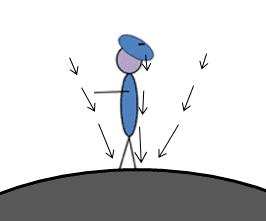
This person experiences a tidal force because gravity is stronger at their feet than at their beret.

Tuesday, 26 January 2016

Adding gravity to the nuclear liquid drop model: stabilizing the all-neutron atom.

The liquid drop model is a formula used to calculate the excess mass of an atomic nucleus based on the different factors that contribute to its total energy. It can tell us whether a given nucleus with a certain number of protons and neutrons will be stable or unstable, and informs us that an all-neutron nucleus is always unstable. However, if we modify the model slightly to include gravitational attraction, we can find how many neutrons are required to make a stable nucleus, and use this to estimate the minimum mass of a neutron star. I think it's a neat application of various physics concepts, so I'm sharing it with you, the readers of this blog.

Exactly like this.

The Liquid Drop Model

The liquid drop model, also known as the semi-empirical mass formula, is an equation used for predicting the binding energy of a nucleus, such that the total mass of the nucleus is the sum of the protons, the neutrons, and the mass due to the binding energy. If the total mass of the system is lower than just a pile of free protons and neutrons (e.g. the binding energy is negative), the nucleus will be bound, and if it is greater than the mass of the particles alone, it will not be bound*. It does a pretty good job at explaining nuclear masses, but is not perfect. The variables in the formula are the number of protons, Z, the number of neutrons, N, and their sum, A=N+Z. The nucleus is treated as a spherical "drop" with a volume proportional to the number of particles that make it up. Typically, there are five terms in the formula:

Each term has a unique scaling with the nucleon numbers, and the strength of each term is determined by the value of the individual Greek prefactors, with dimensions of energy (they are 15.4, 16.9, 0.7, 22.4, and 11.1 in mega electron volts, from alpha to epsilon). I'll briefly discuss what each term means and motivate its scaling. The first is the residual strong attraction**, which is the only term that is always binding (negative). The attraction is so short-range that it can be treated as an interaction between neighbouring protons or neutrons, and the number of neighbour-pairs is proportional to the number of particles, which is why it is linear. The second term has to do with surface-to-volume ratio (the number of particles at the surface scales as the 2/3 power of the volume), and the fact that particles at the surface of the nucleus will have less binding partners than interior particles. This term is most relevant for nuclei smaller than iron, that can increase their binding energy by undergoing fusion. The third term is the electrostatic repulsion between protons, and has the same form as the electric potential of a charged sphere: proportional to the two charges multiplied in Coulomb's force law, and inversely proportional to the radius which goes as the cube-root of volume. The fourth term, which will become more important later in this post, is minimized when the number of protons and neutrons is the same. This can be understood in terms of the Pauli exclusion principle: only two of each kind of particle can be in the same energy level, so each additional pair must have a higher energy. If there are more neutrons than protons, some of the higher energy neutrons can become lower energy protons and overall the excess energy decreases. Or vice versa, if there are more protons. An excess difference between the number of protons or neutrons can lead to either kind of beta decay (although the Coulomb term tends to bias nuclei towards having more neutrons than protons). The last term has to do with the fact that it's energetically favourable to have an even number of protons and an even number of neutrons so that the spins of the particles can align (sort of like a magnetic attraction between pairs, if you will), so an odd number of either will make the energy more positive (bad), while an even number will make it more negative (good).

From Wikipedia's article on the topic, demonstrating that extra neutrons mean extra energy.

So just to give a basic example, if we have iron-56, Z=26, N=30, A=56, and the formula gives us -490 MeV, about half the mass of a proton. The nuclear mass of iron-56 is 55.935 amu, the sum of the protons and neutrons is 56.429 amu, so the difference is 0.494 amu or 460 MeV, so the formula was pretty close, if I did the math right. It's not perfect, but it works. Another thing this model is good at, which is left as an exercise to the reader, is calculating the ideal proton:neutron ratio as a function of A.

The All-Neutron Atom

Neutrons are unstable, because they outweigh a proton by 2.5 electron masses, and will decay into a proton, an electron, and a neutrino after about 15 minutes if left alone. They are stable when part of a nucleus with protons. Could agglomerates of neutrons be stable? There has been some experimental evidence of unstable isotopes emitting correlated neutrons, indicating they perhaps transiently formed a "dineutron." What does the liquid drop model say about this?

If we substitute A=N, Z=0 into the equation, the Coulomb term goes away, but the symmetry term is always there. Now that the binding and symmetry terms are both linear functions of N, ignoring the surface and pairing terms, we have the binding energy going as $N\cdot(\delta-\alpha)$, and because the absolute value of delta is bigger than alpha, the total binding energy is always positive, meaning that bound states of neutrons cannot exist. A clump of ten neutrons would become ten clumps of one neutron and then would become ten protons.

Astute students of physics will realize that the above model does not take into account all the fundamental interactions: every particle exerts a gravitational attraction on every other particle. For charged protons, this is typically like 40 orders of magnitude weaker than the electrostatic repulsion and is totally irrelevant, but neutrons do not experience electrostatic repulsion. Perhaps if we had enough neutrons, the gravitational attraction would overcome the "symmetry"-induced instability of neutronium.

If we add a Newtonian gravitational term to the all-neutron liquid drop model, the negative binding energy scales as the square of the number of neutrons (divided by the cube-root), while the instability scales linearly. Thus, for a very very large number of neutrons, we might expect a stable state to be reached. Let's write down the new equation...


I'm going to go out on a limb and make the assumption that this will be a large number of neutrons, which lets us neglect the surface and pairing terms. I did make one slight change for the Newtonian term: I've explicitly included the mass and radius of the neutron (roughly a femtometer), whereas the charge and radius of the proton were embedded in the definition of gamma in the old Coulomb term. The Newtonian prefactor is on the order of $10^-{36}$ MeV. So, how many neutrons are required for an all-neutron nucleus to be gravitationally stable? We can set $E_B$ to zero and solve for N.

Lots of neutrons.

So by modifying an equation used to predict the mass of nuclei with 1 to 300 neutrons, we have derived a result of $10^{55}$ neutrons to be gravitationally stable. This gives a mass of about $10^{28}$ kg or about 1% the mass of the sun.

Now, stellar-sized gravitationally bound agglomerates of neutrons already sort of exist; they are called neutron stars. They are not 100% neutrons; they have a crust that is still full of protons. The interior structure and composition of a neutron star are also not fully known (it's not even known whether their radius gets bigger or smaller as a function of mass), and the core is basically the "here be dragons" of stellar astrophysics. What is known, however, is that a neutron star must be at least 1.44 times the mass of the sun (the Chandrasekhar limit), because below that it can still be supported by electron degeneracy pressure, and the star is a white dwarf.

The gravitational neutron drop model underpredicted the minimum neutron star size by two orders of magnitude. I still think it's impressive, however, that we extrapolated the model by 53 orders of magnitude beyond its intended use and were only off by another two orders.

Neutron Stars

At this point in the post I'll mention that this calculation was not my idea. I saw it in a talk by John Michael Pearson at McGill in 2014. It was a nuclear talk about stars, which is good because nuclear talks about nuclear physics and astrophysics talks about astrophysics are both too technical for a general physicist, but when someone has to talk to people outside their own speciality, the talks become more accessible. In his talk he introduced this calculation, and then went on to refine it to get a better answer. In particular, he was interested in using this type of reasoning and precise nuclear mass data to derive an upper-bound to the neutron star mass (before it collapses into a black hole), which could be compared to observations of very large neutron stars to verify their description of the nuclear physics. He mentioned in the talk that the recent discovery of a very large neutron star had already ruled out one of his models.

He has a paper on it here, and he got $10^{56}$ neutrons (not sure where our divergence lies, perhaps in a factor of 3/5 that I dropped, or maybe I have to take into account the surface terms), within one order of magnitude of the Chandrasekhar limit, before refining his calculation with nuclear physics that is far beyond what I have encountered.

The way neutron star models are typically derived is by constraining the internal density of the star to the pressure by assuming hydrostatic equilibrium, and further constraining the pressure to the density using nuclear physics***. Because gravitational fields in neutron stars are so intense it becomes necessary to make general relativistic corrections to the hydrostatic equilibrium, so it gets pretty complicated.

So, just to summarize, by adding a gravitational attraction to the liquid drop model, you can make a wild extrapolation and get logarithmically-almost the correct answer, which I think is cool.

*I have read mixed conventions of whether the binding energy is additive and negative, or subtractive and positive. The sentence "adding a negative binding energy reduces the mass and makes the nucleus stable, and a larger magnitude of this energy makes it more stable" describes my convention. If this doesn't quite make sense, imagine pulling the protons and neutrons out of the nucleus and considering how that increases the total energy, and then compare the bound energy to the energy of all the particles at infinity, sort of like gravitational potential.  If this still doesn't make sense...leave a comment.

**Sort of like the van der Waals version of the strong nuclear force. There's a misconception that the strong force holds nucleons together, but it actually holds quarks together inside nucleons, and the residual force holds nucleons together.

***I'm now talking about something I don't really understand so it sounds vague.

Monday, 18 January 2016

The Simpson-Hawking Donut Universe

Your idea of a donut shaped universe is intriguing, Homer. I may have to steal it.-Stephen Hawking, The Simpsons.


In a 1999 episode of The Simpsons, Stephen Hawking discusses a donut-shaped universe with Homer, before punching him in the face with his robotic boxing glove. Is this just a joke by the writers playing on Homer's love of donuts, or does it hint at something deeper? A donut-shaped universe does have physical implications, and observational searches for them neither confirm nor explicitly reject the Simpson-Hawking donut universe.

The mathematical structure resembling a donut is called a torus. It's the shape that is generated if you take a rectangle, attach two opposite sides together so that it forms a cylinder, and than attaching the two circular ends of the cylinder together.
A torus.

A torus is the geometry of the game Asteroids and many others, where going off the screen on one side makes you appear on the others. Solving physics problems on a toroidal geometry can be pretty useful, because you don't have to deal with boundary conditions (Onsager's solution to the square-lattice Ising model is such an example). Conceptually, this cosmic looparound is comforting, avoiding both the edges of the universe and the fact that there are none.

It looks like a rectangle but it's a donut.


Our universe apparently has three spatial dimensions, so if it were donut shaped it would have to be a 3-torus, which is beyond my ability to visualize as its enclosed volume is some kind of hyperdonut in four dimensional space. But what the physical implications of the universe being a 3-donut, and can we look for them?


Even before getting into cosmology, one might want to consider special relativity in a torus. Because two inertial observes can move with respect to one another and cross each others' path multiple times, the so-called twin paradox cannot be resolved by requiring that one of the twins has to change directions in order to compare the elapsed time. The resolution is that in a toroidal spacetime, there is a preferred reference frame, which is the one that makes a given side of the torus appear shortest. So, special relativity in the land of donuts is not the same as the version we are familiar with. This challenges our Copernican sensibilities, because there will be some place and frame from which the universe appears smallest.

Homer Simpson, you are accused of breaking half the Lorentz symmetry of the planet of the donuts.

Considering a cosmological torus, light that is emitted and travels far enough would reach the point where it was emitted, so if we looked far enough we might see another Earth. However, we live in a universe that used to be a hot opaque plasma, so light from that epoch reaches us in the form of the cosmic microwave background, which is seen in all directions, and we can't see beyond that. So even if we can't see another Milky Way, we could detect the donutness of the universe. Consider Earth in a toroidal universe. Light is emitted from some distant point in all directions. Instead of only one of those light rays reaching Earth, many of them take a different path, each arriving at Earth in a different direction. When we look up at the sky, we would see multiple versions of the same image, in a circle whose angular size depended on the relative size of the torus and distance to the source. This took me a while to figure out, so I drew a crappy MS Paint drawing to illustrate it.

Yellow, red, and green all go from the star thingy to Earth in different directions, arriving at different angles in the sky.


As was the case in the photon decay paper, the cosmic microwave background is the most distant light source we have, so this has the best chance of being duplicated by the topology of the universe. To see if this is the case we can look at measurements of the temperature anisotropy of the universe, such as those taken by the WMAP satellite. That's what these guys did, and by their non-observation of obvious cosmic circles (the analysis was considerably more detailed), they placed the bounds of the size of any potential torus at about 78 billion lightyears. I am not sure whether this should be compared with the radius (46 billion lightyears) or diameter (92 billion) of the observable universe. There are a number of independent analyses of this, and to my surprise they do not really rule out the donut universe, although they do not support it either.


If the size of the universe exceeds the size of the torus, the "intersection" will appear at multiple points on the sky.


So, the jury is still out on the Simpson-Hawking donut universe. Did Hawking himself every discuss this? In a 1992 paper on chronology projection, he did brush over it slightly:

"For example, if the initial surface is a three-torus, the Cauchy horizon will also be a three-torus, and the generators can be nonrational curves that do not close up on themselves. However, this kind of behavior is unstable."

However, this kind of behavior is unstable. 

Monday, 4 January 2016

A Living Ising Model: Bacterial Vortex Lattices

Today I read an interesting paper in Nature Physics by Hugo Wioland and friends, called "Ferromagnetic and antiferromagnetic order in bacterial vortex lattices." A lot of Nature Physics is devoted to solid state physics which I personally don't find too interesting, so I almost glossed over until I saw the "bacterial vortex" at the end of the title. In the paper, they grew bacterial colonies in circular cavities that spontaneously rotated, and showed that each colony vortex can behave the way atoms do in magnetic solids, and use it as a jumping-off point to model complex living systems with lattice physics.

A bacterial vortex, taken from the supplemental material of the paper. The graininess is due to me trying to convert from mov to gif and is not part of the paper. The colonies are 50 microns in diameter.
The bacteria, Bacillus subtilis, is covered in flagella which are constantly waving around. The bacteria cannot occupy the same space as one another and so organize themselves in such a way as to avoid that, and influence each other through hydrodynamic interactions of the beating flagella. When they are packed into these circular cavities, they fill the space, and when the flagella beat coherently the colonies start to rotate. One rotating colony they call a bacterial vortex, and they can rotate clockwise or counterclockwise with varying magnitude.

Four connected colonies. The top left and bottom right spin counterclockwise, and the top right and bottom left spin clockwise. (You can see this in the movies from the paper) 

The circular cavities are arranged in a lattice, either square or triangular, with a gap of a certain size connecting each one. Tuning the size of the gaps tunes the interactions between cavities, which are mediated by the row of bacteria on the edge of each circle next to the walls. If the gaps are narrow, the bacteria do not move through and they interact hydrodynamically through the flagella beats, and want to move in the same direction as their neighbour across the gap, which makes the vortices spin in opposite directions. If the gaps are wide, bacteria tend to line up along the walls of the gap, such that a row of bacteria will do a "180" going from one cavity to the next, meaning neighbours will move in opposite directions and thus the vortices will spin in the same direction.

Diagram from the paper of inter-vortex interactions. If the gaps are small, they bacteria at the gaps interact hydrodynamically and move in the same Cartesian direction. If the gaps are wide the bacteria move along the edges, making adjacent cavities rotate the same way. I can foresee my explanation being confusing and unsatisfactory.


This is cool and all, but at this point I should take a step back and actually explain why they are doing this experiment.

Physics is hard. There are very few complex problems that can be exactly solved, but there are computational methods that can get approximate solutions. One of these is called lattice field theory, where space and time are broken into finite-size steps (sites on a lattice), and interactions between adjacent lattice sites are considered and the system is simulated with a computer.

One of the simplest but most ubiquitous lattice models is called the Ising Model*, which is used to understand magnetic materials. In the Ising model, there is a lattice of "spins" that can either be "up" (+1) or "down" (-1), and the total energy of the system depends on whether each spin is pointing the same direction or the opposite direction as its neighbor**. (Imagine two adjacent wire loops with electrical current going around them, and consider the torques they exert on each other if the current is going in opposite directions. Then try to consider a thousand loops.)  Materials where the spins want to point in the same direction are ferromagnetic (like iron) and materials where the spins want to point in opposite directions as their neighbor are called antiferromagnetic (like chromium). Solving the Ising model can be complicated, but it's much simpler than considering the interactions of $10^{23}$ interacting atoms.

A two dimensional Ising lattice, showing ferromagnetic order (left) and antiferromagnetic order (right).


The authors wanted to see they could apply the Ising model to a living system, so the created these bacterial vortices to see if they obeyed Ising-like behaviour. From a thermodynamic standpoint, living matter is substantially more complicated than inert matter: it's constantly producing its own energy and is never in equilibrium. There is a whole relatively new branch of physics just dedicated to studying the thermodynamics of active matter. A network of colonies, each a network of bacteria, each a network of interacting proteins of incredible complexity, would be essentially impossible to model from a "bottom up" approach, but mapping it onto the Ising model would allow its large scale behaviour to be predicted and studied, and may open the door to more generally studying the physics of living systems.

Back to the results of the paper. You may recall that I said that for lattices with narrow gaps, the adjacent bacterial vortices spin oppositely, and for wide gaps adjacent vortices spin in the same direction. The former case corresponds to antiferromagnetism, and the latter to ferromagnetism. By changing the size of the gaps, they can ordain what kind of "magnet" these bacterial colonies will be. The critical size where the behaviour crosses over is about 8 microns.

Left: An antiferromagnetic bacterial vortex lattice, where adjacent cavities tend to spin in opposite directions (alternating green and purple). Right: A ferromagnetic lattice, where neighbors tend to spin in the same direction, with domains of green and purple.
To make the whole thing slightly cooler, they explain the spin-spin interactions between adjacent vortices in terms of an "edge current" of the outer layer bacteria moving along the walls in the opposite direction as all the bacteria in the middle. This is analogous to certain quantum materials such as a quantum hall state in a two dimensional electron gas (a "thin cold semiconductor" doesn't sound as neat), where the electrons propagate in the opposite direction along the outside of the material. Many-body quantum mechanics and bacterial fluid mechanics do not have much in common, but both can be described by this lattice model. I generally think it's neat that these colonies can be modelled as a lattice interacting spins the same way that atoms in a magnet can, even though the first kind of spin is the net motion of the bacteria and the second kind is the intrinsic angular momentum of an electron.

People invariably ask what the practical applications of a given paper are. I will quote the how-we-will-save-the-world-if-we-get-more-funding section from the last paragraph, where the authors state: "Improved prevention strategies for pathogenic biofilm formation, for example, will require detailed knowledge of how bacterial flows interact with complex porous surface structures to create the stagnation points at which biofilms can nucleate."

Overall, very cool paper.

*Named after Ernst Ising and also a good name for a physics hockey team.
**Still haven't decided to go with American or Canadian spelling on this one.