Saturday, 22 October 2016

Visit to the Alcator C-Mod Fusion Reactor at MIT

I recently became aware that MIT had an experimental fusion reactor on campus, so I decided to check it out. After a few back-and-forth emails, I ended up joining a tour that was being given to the Tuft's energy club (yes, Tufts) on Friday afternoon.


MIT's tokamak research began as an offshoot of its magnet research lab (where MRI was developed), that eventually became so large as to spawn a new center and envelop its host. Alcator is an elision of Alto Campo Toro (high field torus), and this is the third iteration of it. It was recently in the news because they had achieved a fusion reaction at a comparatively high pressure, immediately before it was shut off because the US government diverted all fusion research funds to ITER.

The tour began in the lecture room with an overview of the why's and what's of fusion. In discussing the when, the speaker showed the improvement towards the break-even point in fusion reactors over the past several decades, but said that because the tokamaks had gotten so much bigger, they timescale of the experiments had slowed down considerably and now they have to wait several decades for ITER to be ready before their next big learning experience. I talked more about the timeline to fusion here; it's a bit more pessimistic.

"Why use fusion to give plants energy to make sugar and then bury them for millions of years until they form fuel and burn the fuel to make electricity, when we can just use fusion to make electricity?"


Another amusing tidbit the speaker mentioned is that more money has been spent in recent years making movies about fusion (e.g. The Dark Knight Rises, Spiderman 2, etc) than on fusion research itself. He was also overjoyed when someone asked why tokamaks were shaped like donuts and not spheres and he got to cite the hairy ball theorem.

After the speech we went across the street to the facility. There was a big control room where a few people were watching a video and looking at data from the last experiment. There was also a neat demonstration where a plasma was established by running a high voltage across a mostly-evacuated tube, and then a magnetic field was activated that visibly pinched the plasma.


We then entered the room with the tokamak. Most of the room, however, was full of electrical equipment. One of the neatest things I learned was about the way the thing is actually powered. It requires very powerful short lived surges of electricity to power the magnetic coils, on the order of 200 megawatts. To achieve this, they integrate power from the grid and store it in a massive rotating flywheel. The infrastructure for transforming the grid electricity is actually much bigger than the tokamak and its other supporting infrastructure. I was informed that the flywheel is bigger than the tokamak and its shielding, but I wasn't allowed to see it. It is apparently 75 tons and spins up to 1800 RPM, storing 2 gigajoules of kinetic energy.

The flywheel at the Joint European Torus, bigger than Alcator's.

On the wall outside the reactor room was the floor plate from a previous version. It was large.

The tokamak itself is big enough for a person to crouch in, and is surrounded by the wires that generate the magnetic field, and a lot of shielding. The whole thing is about the size of four elephants. It is painted light blue on the outside. On top there is a tank of liquid nitrogen that they use to cool down the copper wires after each heating pulse (which lasts about two seconds). People took photos and asked our tour guide some questions.

Here I am with the reactor (light blue tank thing behind me). You can see the tank of liquid nitrogen on top. The black pipe behind me is the power supply cable for the magnets. Not sure what the cheese grater thingy is.

Afterwards in the lobby there were a few artefacts we could play with, including some of the copper wires used for the field and the superconductors that are replacing them, and some tungsten shielding plates that were visibly damaged from years of hot plasma abuse.

W
Overall, I didn't learn much that I didn't already know about fusion (except the flywheel!) but I'd beat myself up if I knew I worked down the street from a fusion reactor and never went to see it. I appreciate the Plasma Science and Fusion Center guys for putting on the tour, and the Tufts club for (perhaps unknowingly?) letting me crash their event.  Also, one of the safety signs had a typo.


Monday, 10 October 2016

The Nested Logarithm Constants

Depending on your philosophical interpretation of mathematics, I have either discovered or invented a new number: the Nested Logarithm Constant.

$\alpha$=log(1+log(2+log(3+log(4+log(5+....)))))=0.820359862208789788....

As is natural, the logarithms are base-e. I first calculated this number while reading about the nested radical constant, and I wanted to see if something similar existed for logarithms...and it did! While I cannot be certain that others have not examined this number previously, googling the first few digits only yields random lists of digits. I have entered its decimal expansion into the Online Encyclopedia of Integer Sequences, the closest thing that exists to a Wiki of mildly interesting numbers.

It converges quite rapidly with respect to the final digit, being effectively exact after about 5. The plot below shows the convergence with respect to the final digit, and the fractional deviation from the asymptotic value, with an exponential decay shown for comparison.

While it seems obvious empirically that this converges, it is not proven [by me, see update below]. As far as I can tell, a proof of the convergence of the nested radical constant is also lacking. I would suspect that the nested logarithm constant is both irrational and transcendental, and there is a short proof that the logs of integers are irrational, but I'm not aware of a proof that nested logarithms are irrational.

There are a few extensions one can examine. Changing the base of the logarithm changes the value of the final number, decreasing with increasing base towards zero, and towards infinity with decreasing base.

Another extension is to include an exponent on the integers, such that the number becomes:

$\alpha_{N}=\log(1+\log(2^{N}+\log(3^{N}+...)))$

When N is large, 2$^N$ will be much larger than log(3$^N$+...), so we can take the N out of the exponent and see that $\alpha_{N}$ approaches log(1+N·log(2))  log(N)+log(log(2)). The difference between $\alpha_{N}$ and its large-N approximation decreases inversely with N, with a prefactor empirically* very close to the square root of two. With this reciprocal correction, I can almost write down a closed form expression for $\alpha_{N}$, except it starts to diverge close to N=1, and I don't know if it's a coincidence or not (where does the square root come from?). I would be interested in exploring this further to try to find a closed form expression for the 0.82...constant.

The nested logarithm constants as a function of the exponent, and the deviation of two approximations.
There is one more related number of interest. I can calculate log(1+2·log(1+3·log(1+4·log...)))) which converges to roughly 1.663.... I have not investigated this in as much detail, but it is empirically very close to the Somos Quadratic Recurrence Constant, which can be calculated as √(1√(2√(3√(4...)))) and converges to 1.662. Unless I'm lead to believe otherwise I will assume that this is a coincidence.

This investigation started with me playing around with logarithms and seeing what came out, and lead to a few findings that I think are kind of interesting. Maybe when I have the time and energy I'll investigate this further and be able to determine if the nested logarithm constant has an exact value. There is a journal called Experimental Mathematics, which is basically what this is, so perhaps I can send it there.

UPDATE: A commenter on reddit, SpeakKindly, has put forward a simple proof of convergence by establishing an upper bound using induction. I will repeat it here for the readers:

First, consider the related term log(a+log(a+1+log(a+2+log...(log(a+k)))) for some k and a>1. SpeakKindly proved this is less than a for all k. The base case, for k=0, we have no nested terms and just have log(a), which is less than a. Then we assume this is true for k-1 nestings, so we have log(a+log(a+1+log(a+2+log...(log(a+k)))) < log(a+(a+1))=log(2a+1), which is always less than a. The nested logarithm constant is the log(1+(the above term for a=2)), which is less than log(1+2), thus the nested logarithm constant is less than log(3).

Another user, babeltoothe, used a different argument using the integral definition of the logarithm, where the upper limit of each integral was another integral.

*Best power-law fit is 1.004√2 for the prefactor and -0.998 for the exponent.

Saturday, 27 August 2016

What's the deal with fusion power?

"Fusion is the energy of the future...and always will be."
I recently attended a seminar at the MIT Plasma Science and Fusion Center from a director of the ITER project about the prospects of a commercial fusion reactor. I decided to write a post about why fusion always seems to be 50 years away and what needs to happen to make it a reality. What it comes down to, is that it requires a huge initial investment that nobody wants to pay for.

The SimCity 2000 transit advisor understands the challenges facing the fusion plants in his city.


The most-studied system for fusion is the tokamak (from the Russian for toroidal chamber with magnetic coils), which is a big donut-shaped chamber with a plasma inside, with a strong applied magnetic field that keeps the plasma confined in thin ring-shaped region in the middle of the torus. The plasma is heated up by driving it with electric fields and inducing Joule heating. If the plasma gets  hot enough, it can begin  to fuse hydrogen into helium, which produces a lot of excess energy in the form of neutrons, gamma rays, and overall heat. The heat is used to boil water to run a turbine. While the sun typically fuses four protons into helium (the p-p chain), the most accessible reaction is deuterium-tritium fusion, which has a lower energy barrier. Tritium is extremely rare naturally, but it can be produced by surrounding a nuclear reactor or the tokamak itself with lithium, which becomes activated by the neutron flux and then decays into tritium.


The inside of the Joint European Torus tokamak, with a view of the plasma.
Fusion research began after the Second World War, not only towards the development of hydrogen bombs but also for power generation, with plasma systems getting bigger and hotter over the next few decades. Due to the Cold War, a lot of this research was classified.


The sad graph

In 1976, fusion researchers in the US wrote a report about future prospects for fusion power, suggesting that with appropriate funding fusion power would be realized within 15 to 30 years. They also predicted that with current levels of funding, they would not be able to achieve their goals in the foreseeable future. The actual funding reality since 1976 has been even bleaker than that. So it's not just scientists always saying that it's 20 years away and not making any progress, it's the lack of investment that prevented those 20 years from counting down. Their prediction was correct.

Prediction of fusion progress from 1978 based on funding, compared to the actual historic funding for fusion in the US. Even though this graph looks like it was drawn in Microsoft Paint, I have looked up the source material and this graph represents it accurately.
The reality is that the science and technology required for fusion power is ready to go, there are just a number of engineering and economic challenges that need to be overcome. Not engineering challenges like "how do you make a magnet that big" but more like "we need a gigantic building with complicated plumbing that won't expose its workers to radiation." We know how to build a giant magnet donut and fill it with plasma, it just needs to be made big enough to generate power, and big is expensive.

The Future

The next step in this direction is ITER (International Thermonuclear Experimental Reactor), a giant tokamak being built in France. Its main goal, from what I've read, is to generate ten times more power than it requires to operate (although this still won't make it viable as a power plant). It has gone massively overbudget and is now expected to run a tab of 20 gigaeuros. I think, moreso than any plasma science objectives, this will shed a lot of light on what is required to engineer a facility of this magnitude.


ITER, dream and reality.


At the fusion seminar I attended, a director of ITER was talking about his ideas for a commercially viable fusion reactor, which would have to be much bigger than ITER. One of the reasons tokamaks are so expensive is that they have to be really big. The fusion reactor would require about 500 megawatts just to maintain the fusion reaction: beyond that, power can be sold to the grid. However, if it's just selling an extra 50 megawatts after that 500, the electricity would have to be extremely expensive to cover the costs of the plant. It is estimated that a fusion plant would have to generate at least 2.5 gigawatts of electricity (slightly more than Hoover Dam) in order to sell the electricity at a cost comparable to current power sources. Thus, the minimum sensible infrastructure investment is that which is needed to make a plant that big. Not all of this goes into the generator itself, a lot of it goes into the building that houses it, as well as the plumbing necessary to extract tritium such that the reactor can keep making its own fuel.

The price tag that he quoted was 30 billion dollars, plus maintenance costs and morgtage payments over the next sixty years totalling over 100 billion, but it would produce enough power that that electricity could be sold at grid prices. A debate arose in the seminar about the economics of choosing the ideal initial size, about which costs scaled super-linearly with size and which scaled sub-linearly. It was pointed out that the first fission reactor was not sufficiently large to produce electricity that could be sold at a reasonable price, but the fact that it demonstrated that the technology was viable lead to investments in bigger nuclear plants. After the first viable fusion reactor is built, it won't be as difficult to build the next one.

The speaker claimed that what was required for this to actually exist was a rapid increase in fossil-fuel prices that would be driven by scarcity and increased energy usage in China and India. He cited $200/barrel as roughly the price at which a 30 billion dollar fusion plant would seem like a not-crazy investment. However, I've heard this story before; the rise in prices in the last decade made it viable to extract oil from fracking and from the Canadian tar sands and didn't give us a renewable energy revolution. Someone in the audience mentioned that General Electric was now developing its coal power technology, even dirtier than oil, to placate the rising energy demand in China.

The National Ignition Facility

I'm mainly discussed magnetic confinement fusion, but I'll also mention the National Ignition Facility (NIF) that was built for fusion research and then hastily re-purposed. The idea was to fire an extremely powerful laser at a small deuterium-tritium pellet such that it rapidly compressed and heated up until it was so hot and dense that fusion ignited. To this end, they built the world's most powerful laser array that was basically in inverted Death Star, with all the lasers focused on a little target at the center. They gradually ramped up the power, occasionally publishing papers about the behaviour of shock waves and the radiation emitted from these tests, and just as they were on the verge of getting powerful enough for fusion, that aspect of the project was halted and the facility was turned into a materials characterization facility and a way to test whether the fuel in nuclear bombs still works, without detonating the bombs themselves. I really wish they'd keep trying for fusion.

NIF from the outside and inside.
ITER and NIF aren't the only extant fusion projects, there is also a really cool looking one in Germany called the Wendelstein 7-x and the American Z-Machine as well as smaller facilities around the world, and I hope the future of fusion is brighter than what was laid out at that seminar.

Sunday, 21 August 2016

The duplication of BioMed Central.

This post is about something strange that happened in 2014 and my attempts to deal with it.

Towards the end of my master's, I wasn't sure what to do next, so I picked up a part time consulting job, basically looking into public health statistics and compiling the trends and developing models to forecast them. I ended up doing a Ph.D. after my master's but I kept doing this job on the side. The first project I worked on involved the epidemiology of tuberculosis in Quebec, which is a fairly serious problem up North. It lead to two papers, one looking at the statistics and one forecasting them into the future. Working on these papers was a good learning experience but I would say that they are not as good as my physics papers, which I am more proud of.

The second paper was published in BioMed Central (BMC) Public Health. BMC is a massive journal network owned by a massive publishing company, Springer, and there are over 100 BMC journals, which I believe are all pay-to-publish open access. Pay-to-publish always seems kind of sketchy but there was definitely a peer-review process.

One day, I was compulsively checking my citations on Google Scholar and noticed that there was a new citation to my first TB paper, bringing the total up to two. I clicked to see who cited me, and found that the two citations were 1. my second TB paper on BMC Public Health, and 2. also my second TB paper, on the domain science-project.ru (don't bother going there, it's just an ad site now). My paper was randomly hosted on this Russian website with no explanation, so I decided to look into it. I found that the entire BMC database, consisting of hundreds of journals and tens of thousands of papers, was completely duplicated on this Russian server, with no explanation. I don't understand why someone would do this, and the BMC papers are free to read anyway. In addition to duplicating my paper, they also had links to rough pre-publication versions of the paper, including MS Word track-changes notes, that were still hosted on the BMC server.

I decided to contact the editor-in-chief of BMC, who was nominally in the UK but actually in Cyprus. I mentioned the serious issue that their whole website was duplicated on a Russian website, and the less serious issue that my rough drafts were still being linked to. The editor responded to me saying:

Please note that authors of articles published in BMC Public Health are the copyright holders of their articles and have granted to any third party, in advance and in perpetuity, the right to use, reproduce or disseminate the article, in its entirety or in part, in any format or medium, provided that no substantive errors are introduced in the process, proper attribution of authorship and correct citation details are given, and that the bibliographic details are not changed. If the article is reproduced or disseminated in part, this must be clearly and unequivocally indicated. Please see the BioMed Central copyright and license agreement for further details.

Furthermore, as stated in our ‘About this journal’ page (http://www.biomedcentral.com/bmcpublichealth/about#publication) the pre-publication history including all submitted versions, reviewers' reports and authors' responses are linked to from the published article. We are unable to remove the pre-publication history of the manuscript following its publication in the journal.
 In other words, she completely ignored the fact that I was trying to tell her about HER ENTIRE JOURNAL NETWORK being pirated, and instead decided to focus on a minor editorial policy. That was honestly a bit disturbing, how little she cared. I sent another email telling her that she ignored the important part of my email and asking if it bothered her that her entire journal database was copied on another website.

Meanwhile, I looked for a better way to get into contact with somebody in charge, because the editor of the journal didn't seem to care. I managed to find the secure whistleblower ombuds page for Springer, which is basically for people who want to report scientific fraud and related misconduct. I left a message explaining the situation, and my concern as to how casually the editor seemed to be taking it. A few days later I got two messages, an email from the editor apologizing for the misunderstand, and a secure message in the ombuds inbox from the legal team:

we have looked into this and the Legal Department will approach the contact that it given on the (fake) site. Please rest assured that Springer takes piracy very serious. In order to protect our authors´ rights and interests, Springer proactively screens websites for illegal download links of Springer eBooks and subsequently requires hosts of such download sites to remove and delete the files or links in question. This necessary action has become increasingly important with the growing number of eBooks within the Springer eBook collection.
Eventually, the fake version of BMC on science-project.ru disappeared and my citation count went back down to 1, and the issue appeared to be resolved. I am still left wondering, however, why someone would bother duplicating a massive network of free papers to their own server, and the whole incident with the editor left me a little wary of BMC.

Sunday, 31 July 2016

DNA Waves: New paper in Physical Review E.

In June I submitted my latest paper to Physical Review E, and today it was published. I also uploaded a preprint to arxiv.org, and that free version can be found here. It is (probably) the last paper from my PhD work, which I wrote on-and-off in my spare time over the last year. Here, I'll briefly summarize what the paper is about.

A DNA molecule snaking its way through an array of cavities (which are separated by about a micron). The paper is about how "waves" appear to propagate along the DNA molecule.


As I've mentioned in some  other articles, my Ph.D. work was about the physics of DNA molecules trapped in cavities connected by a narrow slit. I was studying this both to better understand polymers in geometries using DNA as a model system, and to possibly develop genetic sequencing technology. The first paper I published on this was about diffusion through these cavities, and most of my Ph.D. I spent working on measuring the entropy loss involved in confining DNA. Towards the end I started working on a paper looking at how long it takes DNA to fluctuate from one cavity to another, which we described in terms of modes of a coupled harmonic oscillator system. That was published last summer.

From my two-pit fluctuations paper.


One day I did an experiment using much longer DNA than usual, and I noticed something cool: when you look at videos of the molecules, it looks almost like there are waves propagating back and forth along the molecule. I decided to investigate that, and that's what the paper was about.

Do you see the waves?
Looking at these movies you can sort of convince yourself that there are these transient waves, and a good way to look at how these things propagate over time is through a kymograph, which averages out one spatial dimension so you can see how the profile in the other dimension evolves over time. Doing this, you can see diagonal streaks of brightness, which are the propagating waves. You can see both positive waves, where excess DNA propagates between the pits, and negative waves, where paucity propagates, which are analogous to electron holes in a semiconductor. I also thought I could see evidence of waves reflecting off the end of the molecules, although that didn't make it into the final paper.

A wave of brightness propagating through a molecule.
The main way I analyzed the data was through correlation functions. A correlation function basically measures the probability that a deviation from the mean of one thing leads to a deviation from the mean in another thing. In my two-pit fluctuation paper, I was looking at the cross-correlation between the intensity in one pit and the other, and since DNA is just going from one pit to the other, if the intensity pit 1 deviates upward from the mean, it's very likely that pit 2 has deviated downward, so they are anti-correlated. At short time-scales this anti-correlation is strong, while at long time-scales it decays towards an uncorrelated noise floor.

This is from an actual presentation I gave at group meeting.
With two pits this is simple, but with a larger number it gets complicated. With three pits you have one-two, two-three, one-three, plus the autocorrelation functions one-one, two-two, and three-three. In general for N pits you have N(N-1)/2+N unique correlation functions, which provide a lot of information. My biggest molecule was in 15 pits, which would give 120 correlation functions. We decided to focus on correlations between neighboring pits: 1-2, 2-3, 3-4 etc. This would allow us to look at the process of DNA leaving one pit and going to the next one, then from that one to the next one, etc.

Basically what we observed was that any given point in time, neighboring pits were anti-correlated (as expected, because if there's more DNA in one pit it's less likely to be in another), and then that grew to a positive correlation at some later time (this is the propagation of the "wave": excess DNA in one pit at one time is more likely to be found in a neighboring pit at a short time later), and then a long-time decay (everything averages out due to random thermal motion).

Cross-correlation functions between different pit intensities. At zero time (A), they are anti-correlated because DNA in one pit is less likely to be in another. At a short time later (B), they are positively correlated, because the excess DNA at A is likely to have reached B at this time. At long times (C), random fluctuations bring correlation down to zero. This is the meat of the analysis.

This pattern was repeatably observable for all these large-N systems, which gave us a lot of data on how these waves propagate through confined DNA. We could also see something similar looking at next-nearest neighbors, and even next-next-nearest neighbors. The hard part was understanding all this data and what it was telling us about the underlying physics that lead to these waves. Presumably, such an explanation would allow us to predict what these correlation functions look like.

When the DNA molecule is at equilibrium, there is a certain length in each cavity (the ideal length balances its own self-repulsion and the entropy loss from the slits), and a certain tension in the strands linking each cavity. If, due to a thermal fluctuation, one cavity has an excess of DNA, the whole system gains some energy that is harmonic with respect to the excess length of DNA, and this excess is diminished as DNA is transferred to adjacent cavities through propagating changes in tension in the linking strands.

Because of the harmonic energy cost and my previous work mapping the two-pit system onto harmonic oscillators, the way I initially thought of the waves was in terms of a chain of harmonic oscillators, where a disturbance in one propagates down the chain as a phonon. It is a bit tricky to map this phenomenon onto a polymer in solution, because it is overdamped and effectively massless, so there is no momentum that is conserved. I spent a while trying to figure out the theoretical correlation function for an overdamped harmonic chain in thermal reservoir, and writing Monte Carlo simulations thereof, but that only got me so far.
One dimensional random hopping on an array. This model turned out to describe our system very well.
A simpler model turned out to work better: if you just imagine a bunch of Brownian random walkers on a one-dimensional lattice, each with some random probability of hopping in either direction at some rate, you can show that this system gives rise to collective motion which is exactly solvable and evolves in time in a way that looks like our observed correlation functions. In our system, we can treat the DNA as randomly fluctuating in either direction, but fluctuations are more likely in a direction that reduces excess DNA in a cavity, and that is essentially what the multi-hopping model is describing. A lot of the paper involves matching the predictions of the model to our observed correlation functions. It turned out to be different than I had initially envisioned it; I was originally thinking of it in terms of sound waves propagating through the molecule as tension perturbations.

I like this paper because it started out as an investigation of a neat phenomenon I happened to observe, and lead to something more systematic that we eventually understood in terms of some fairly fundamental statistical physics.  I'm glad the reviewers liked it too!

Update: this post was modified after the paper was published.

Thursday, 28 July 2016

Do radioactive things glow?

In a lot of depictions of radioactive materials, there is a green glow that is emitted. This is so common the green glow itself is associated with radioactivity. Does this green glow exist, and if so, where does it come from?

This animated plutonium rod should not be confused with the inanimate carbon rod, which does not glow.


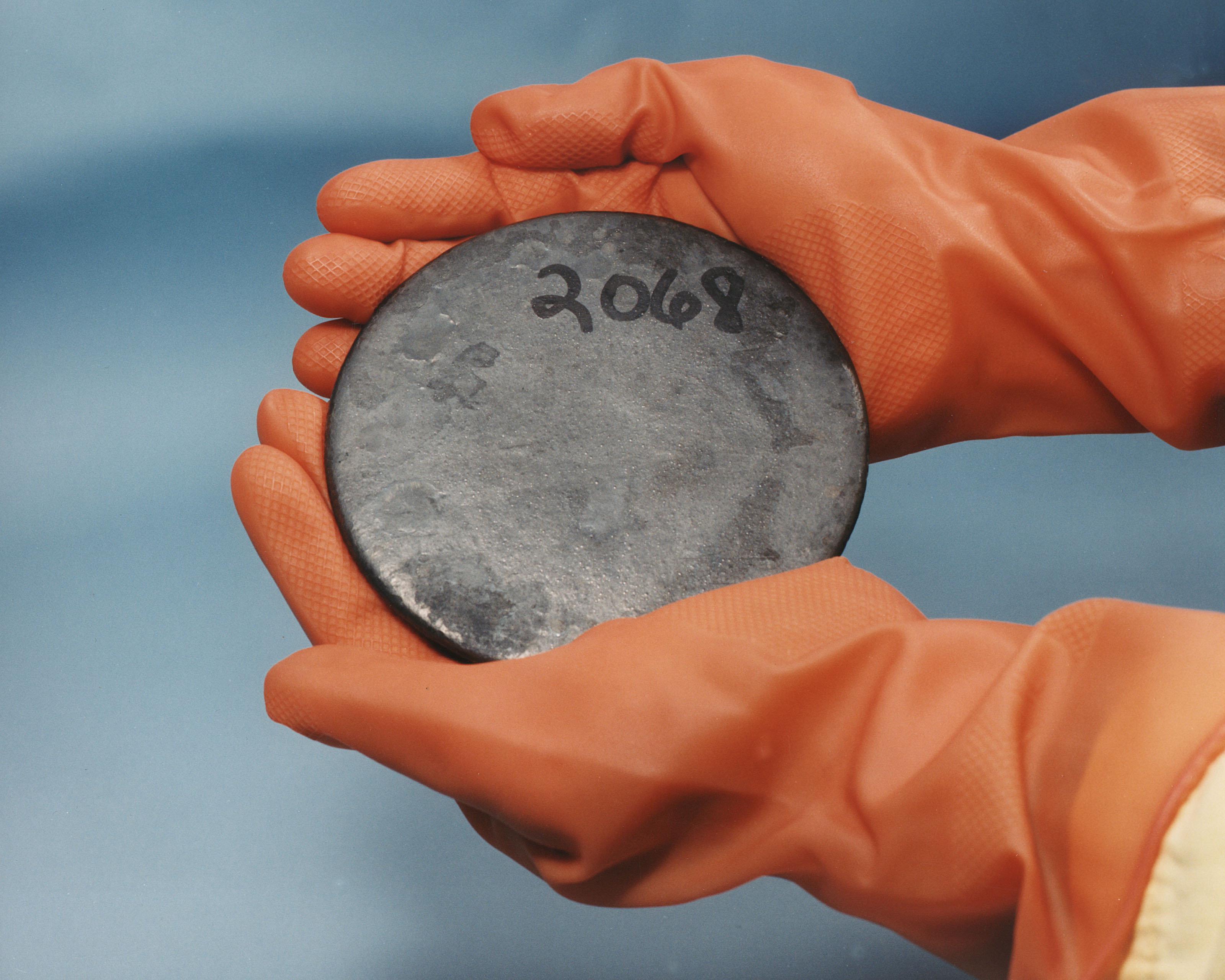
Radioactive materials such as uranium and plutonium do not, by themselves, glow. Pure uranium looks like a boring grey metal, and plutonium is slightly shinier. The glow associated with radioactivity originates from materials containing radioactive isotopes, but is due to electronic rather than nuclear transitions, similar to how certain materials glow under a blacklight. These materials can glow without an external power supply, because the atomic transitions can be excited by the radioactive decay. This is known as radioluminescence.

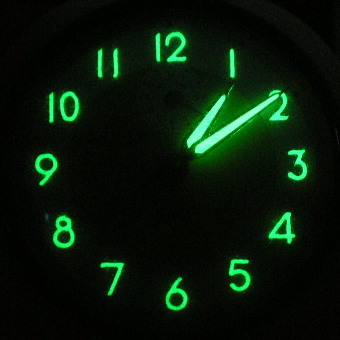
Radioluminescent materials were more common in the early 20th century, before it was understood how incredibly bad for you extended radiation exposure is. Clock faces often had dials painted with radium, so that they could be read in the dark. The luminescence was actually produced by zinc sulphide, which was activated to an excited state by the radium decay. Radioluminescent watches can still be purchased, but they use the safer tritium as an isotope.

Another common product was uranium glass, which was marketed as vaseline glass, apparently because it was the same colour as petroleum jelly was at the time. Once again, it is not the uranium producing the light, but the transitions excited by its decay.

Uranium glass glowing green.. The blacklight in the background is the main source of illumination.
Perhaps the most common radioactive green movie trope is plutonium, but plutonium is not used in radioluminescent compounds. It can appear to glow red, but that is due to a chemical reaction with oxygen (aka burning) rather than anything associated with radioactivity.

All of these heavy-element radioluminescent materials rely on alpha-decaying isotopes. Alpha particles tend to move slowly (compared to light) and are comparatively safe; alpha radiation can essentially be blocked by clothes, but if you inhale a piece of alpha-emitting dust you can be in serious trouble. The main scenario where radioactivity does produce a glow is not from alpha decay but beta decay*, typically in nuclear reactors. Nuclear reactors are often kept underwater, for cooling and for neutron shielding, and when emitted beta particles (electrons) exceed the speed of visible light in water, they emit Cerenkov radiation, which manifests itself as a blue glow (This is analogous to a sonic boom when something exceeds the speed of sound).

Cerenkov radiation from a nuclear reactor.
So just to summarize, radioactive materials do not emit light just because they are radioactive, but essentially act as a power source to make other things glow. Except nuclear reactors, those actually glow.

*Electrons are 1/7000th the mass of alpha particles, making them much faster at the same energy.

Monday, 18 July 2016

"What's the application?": Genetic sequencing and polymer physics

Long time no post. I wrote an article on PhysicsForums trying to explain a few of the applications of my field of research, and how they relate to some of the physics problems. Check it out!

https://www.physicsforums.com/insights/whats-application-polymer-physics-genetic-sequencing/